LOADING...

support@tourpanda.in +91 8766373460

Tour Panda Insights

Explore beautiful destinations, dynamic travel packages, and expert guidelines.

Tour Panda
Tour Panda Exploration
Sep 01, 2026 By Admin
Honeymoon Tour Packages Compared & Booked on Tour Panda

Honeymoon Tour Packages 2026: Compare Destinations, Costs & Book Smart on Tour Panda Picking the right honeymoon tour packages shouldn't feel like a second wedding. The market is flooded with glossy brochures, suspiciously cheap deals, and vague promises of "luxury inclusions" — yet 59% of couples in 2026 now choose a mini-moon first, then upgrade to a bigger trip later, according to Fora Travel's Wedding & Honeymoon Report. That means today's honeymooners want flexibility, transparency, and a partner they can actually trust. Whether you dream of Bali's rice terraces, Vietnam's misty Sapa mountains, or Kerala's houseboat sunsets, this guide breaks down what honeymoon tour packages really include, what they cost in 2026, and how to book without the stress. By the end, you'll know exactly how to compare packages, spot red flags, and pick an operator that delivers the trip you actually imagined. TL;DR / Quick Answer Honeymoon tour packages are pre-curated travel bundles built for couples — typically bundling accommodation, transfers, sightseeing, and often romantic add-ons and visa support. In 2026, popular international honeymoon tour packages from India start around ₹17,999 per couple (Bali, Vietnam Sapa) and scale up by destination, season, and inclusions. The smartest way to book is to compare packages side-by-side, verify the operator's credentials, and pick flexible options matching your travel style — whether a quick mini-moon or a longer international escape. Table of Contents What Are Honeymoon Tour Packages and Who Are They For? Top Honeymoon Destinations for 2026 (Comparison Table) Honeymoon Tour Package Cost Breakdown by Tier Best Season for Your Honeymoon by Region Choosing the Right Honeymoon Tour Operator — Trust Scorecard Sample Itineraries: Bali, Vietnam Sapa, Kerala & More Packages for Different Travel Styles (Couples, Mini-Moon, Anniversary) Offbeat Honeymoon Circuits Worth Considering Booking Safely: Red Flags and What to Verify FAQs on Honeymoon Tour Packages What Are Honeymoon Tour Packages and Who Are They For? Honeymoon tour packages are pre-designed travel bundles crafted for newlyweds and couples celebrating a milestone. They typically combine accommodation, airport transfers, guided sightseeing, romantic add-ons like candlelight dinners or couple's spa sessions, and increasingly, visa support for international destinations. The real value isn't just convenience — it's that the package handles logistics while you focus on each other, which is why travel agencies still capture the largest share of honeymoon bookings globally (Grand View Research, 2025). So who are these packages actually for in 2026? Beyond the classic newlywed couple, modern honeymoon tour packages serve a wider audience: the "mini-moon" couple wanting a short escape right after the wedding, the anniversary couple marking a milestone, the destination-wedding couple planning a post-ceremony getaway, and even solo travellers bringing a partner along later. The Knot's 2024 study found 69% of US couples took a honeymoon, and 59% travelled internationally — proving structured packages, especially for international routes, are how most people actually book. The key is matching the package to your travel personality: adventure lovers should look for treks and outdoor itineraries, beach couples should prioritise all-inclusive resorts, and culture seekers should opt for slower-paced circuits

Tour Panda
Tour Panda Exploration
Aug 31, 2026 By Admin
Kuari Pass Trek 2026: Route, Cost & Itinerary Guide

Kuari Pass Trek 2026: Route, Cost & Itinerary GuideThe Kuari Pass trek remains one of the Himalayas' most underrated moderate adventures — a route Lord Curzon himself walked in 1905, now accessible to weekend warriors looking for genuine altitude without the crowds of Roopkund. Sitting at 12,516 feet inside the UNESCO-listed Nanda Devi Biosphere Reserve, Kuari Pass offers sweeping views of Nanda Devi, Dronagiri, Kamet, and Trishul peaks that rival any high-altitude trek in India.This 2026 guide covers everything you need to plan the Kuari Pass trek independently or with a guided package — official route distances, government-verified permit fees, a tested 5-day itinerary, realistic cost breakdowns, and the latest safety information following the 2023 Joshimath subsidence. Whether you're a first-time Himalayan trekker or an experienced hiker seeking a shoulder-season escape, the sections below will help you decide if Kuari Pass fits your 2026 calendar.TL;DR / Quick AnswerThe Kuari Pass trek is a moderate 5-day Himalayan trek in Uttarakhand topping out at 12,516 ft (3,815 m) inside the Nanda Devi Biosphere Reserve. The standard Joshimath–Gulling–Khullara–Kuari Pass route covers 33–37 km over 4–5 days and suits fit beginners with some prior hiking experience. Total trip cost in 2026 ranges from ₹8,500 for a budget DIY trek to ₹15,000 for a guided package, with the Uttarakhand Forest Department charging fixed permit fees of ₹100 (Indians) and ₹200 (foreigners). Best months: April–June and September–November.Table of ContentsKuari Pass Trek: An OverviewRoute, Distance & AltitudeBest Time to VisitDay-by-Day ItineraryCost BreakdownHow to Reach JoshimathPreparation & TipsFAQsKuari Pass Trek: An OverviewThe Kuari Pass trek — also called the Lord Curzon Trail — was first explored by British Viceroy Lord George Curzon in 1905, and the route still follows his original path through Garhwal's alpine meadows. According to trekking histories, Curzon asked local villagers the Garhwali word for "virgin," was told "Kunwari," and used it to name the untouched snowfield. His expedition route ran from Ranikhet through Gwaldam, Ramni, and Pana before crossing the pass and descending to Ghat near Nandprayag — a journey that still feels remarkably untouched more than a century later.The trek begins from Dhak or Joshimath inside the buffer zone of the Nanda Devi Biosphere Reserve, India's second biosphere reserve and a UNESCO Man and the Biosphere (MAB) site designated in 2004, spanning 6,407 sq km across Chamoli, Pithoragarh, and Bageshwar districts. Because of this protected status, every 2026 trekker must obtain a forest entry permit from the Joshimath Range Office and carry Aadhar or a passport. Foreign nationals are registered at the Joshimath police station before proceeding. Tour Panda - Book Your Kuari Pass Trek Package to skip the permit confusion and let verified agents handle documentation in advance.Kuari Pass Trek Route, Distance & AltitudeThe most popular 2026 Kuari Pass trek route follows Joshimath → Dhak → Gulling → Khullara → Kuari Pass → Khullara → Tapovan, covering approximately 33–37 km over four to five days. According to the Uttarakhand Tourism Development Board, the trek distance varies from about 20 km for a short Dhak–Kuari Pass–Auli crossover to 35–37 km for the longer Joshimath–Gulling–Khullara–Kuari Pass return loop. The shorter variant is ideal for first-timers with limited days, while the full loop offers the complete Curzon experience with two high-altitude camps.Altitude progression is steady and manageable: Joshimath sits at roughly 6,150 feet, Gulling at around 9,000 feet, Khullara at 11,000–11,800 feet, and the pass itself at 12,516 feet. This gradual climb is why the trek is rated moderate rather than difficult — the only real challenge is the final 1,200-foot push from Khullara to the pass, which crosses open snowfields in early season. For trekkers who want to compare alternatives across the Garhwal and Kumaon Himalayas, Browse Himalayan Trek Packages on Tour Panda's curated portfolio, which also covers Valley of Flowers and the Spiti Full Circuit.Best Time to Visit Kuari PassThe best months for the Kuari Pass trek are April, May, June, September, October, and November — essentially the pre-monsoon and post-monsoon windows. April and May are particularly photogenic because rhododendrons bloom along the lower forests and snow still caps the higher peaks, creating the classic Curzon Trail postcard view. September and October offer the clearest skies of the year, with stable weather, fresh post-monsoon greenery, and excellent visibility for the Nanda Devi and Dronagiri panoramas from the pass.July and August should be avoided due to heavy monsoon rain, landslides on the Joshimath–Rishikesh highway, and leech-infested lower sections. December through March brings heavy snow that closes the Khullara campsite and makes the final pass crossing potentially dangerous without technical gear — only experienced mountaineers with proper equipment should attempt the winter Kuari Pass trek. If your 2026 plans fall in shoulder months like early April or late November, book buffer days in Joshimath to wait out unexpected weather; most guided packages include one or two spare days specifically for this reason.Day-by-Day Itinerary for Kuari Pass TrekBelow is a tested 5-day Kuari Pass trek itinerary used by most 2026 guided groups, balancing acclimatization, summit timing, and return travel. Day 1: Arrive Joshimath (6,150 ft) from Rishikesh or Haridwar — a 9–10 hour drive — rest, complete forest permit check, and stay overnight in a guesthouse. Day 2: Drive 12 km to Dhak village and trek 8 km to Gulling campsite (9,000 ft) through oak and rhododendron forest, approximately 4–5 hours. Day 3: Trek 6 km to Khullara (11,000–11,800 ft), about 3–4 hours, with a short acclimatization walk in the afternoon.Day 4: The summit day — start pre-dawn around 4:00 AM, climb 4 km to Kuari Pass (12,516 ft), spend 30–45 minutes at the top photographing the Nanda Devi and Trishul panorama, then descend 10 km back to Gulling or continue 6 km further to Tapovan (8,300 ft) for a hot spring soak. Day 5: Trek 4 km to Joshimath via the Auli road and drive onward to Rishikesh or Haridwar, arriving by evening. The entire trek covers roughly 28–30 km on foot over the five days. If you'd like this itinerary customized for your fitness level, group size, or photography priorities, Get a Customized Kuari Pass Trek Itinerary from Tour Panda travel experts in under 24 hours.Kuari Pass Trek Cost BreakdownThe 2026 Kuari Pass trek cost has three layers: government-verified forest fees, on-trek operational expenses, and operator package rates. According to the Uttarakhand Forest Department's published schedule, the forest entry fee is fixed at ₹100 per Indian/SAARC trekker and ₹200 per foreigner; guide and porter fees are ₹50 each, and mule charges are ₹50. Camping costs are modest — ₹100 per day for a 2-person tent (Indians) and ₹200 (foreigners), scaling up to ₹300 per day for larger kitchen or mess tents. These permit charges are non-negotiable and must appear on every legitimate package quote.On-trek daily expenses (meals, tent rental, mules, cook) typically run ₹1,500–₹2,000 per person per day, putting

Tour Panda
Tour Panda Exploration
Aug 31, 2026 By Admin
Char Dham Pilgrimage Tour: Plan Your Sacred Yatra 2026

Char Dham Pilgrimage Tour: Plan Your Sacred Yatra 2026IntroductionA Char Dham pilgrimage tour in 2026 looks very different from the yatras your grandparents remember. The 2025 season drew a record 51,04,975 pilgrims, and the Uttarakhand government has responded with new health rules, a 30% cut in helicopter seats, and stricter registration at registrationandtouristcare.uk.gov.in. The four shrines, Yamunotri, Gangotri, Kedarnath, and Badrinath, still open in sequence from April 19, but the journey now demands real planning. This guide brings together the official 2026 dates, the actual cost of road and helicopter packages, the safest weather windows, and the medical clearance rules you cannot skip, so your sacred yatra feels devotional, prepared, and unhurried.TL;DR / Quick AnswerThe 2026 Char Dham pilgrimage tour opens on April 19 (Akshaya Tritiya) with Yamunotri and Gangotri, Kedarnath on April 22, and Badrinath on April 23-24, closing between November 10 and 13. Mandatory online registration, fitness certificates for pilgrims above 55, and capped helicopter capacity at 70% define this season. A 10-12 day Char Dham pilgrimage tour from Haridwar costs ₹18,000-45,000 per person for road-based packages and ₹65,000-1,20,000 with helicopter darshan at Kedarnath.Table of ContentsChar Dham Pilgrimage Tour: An

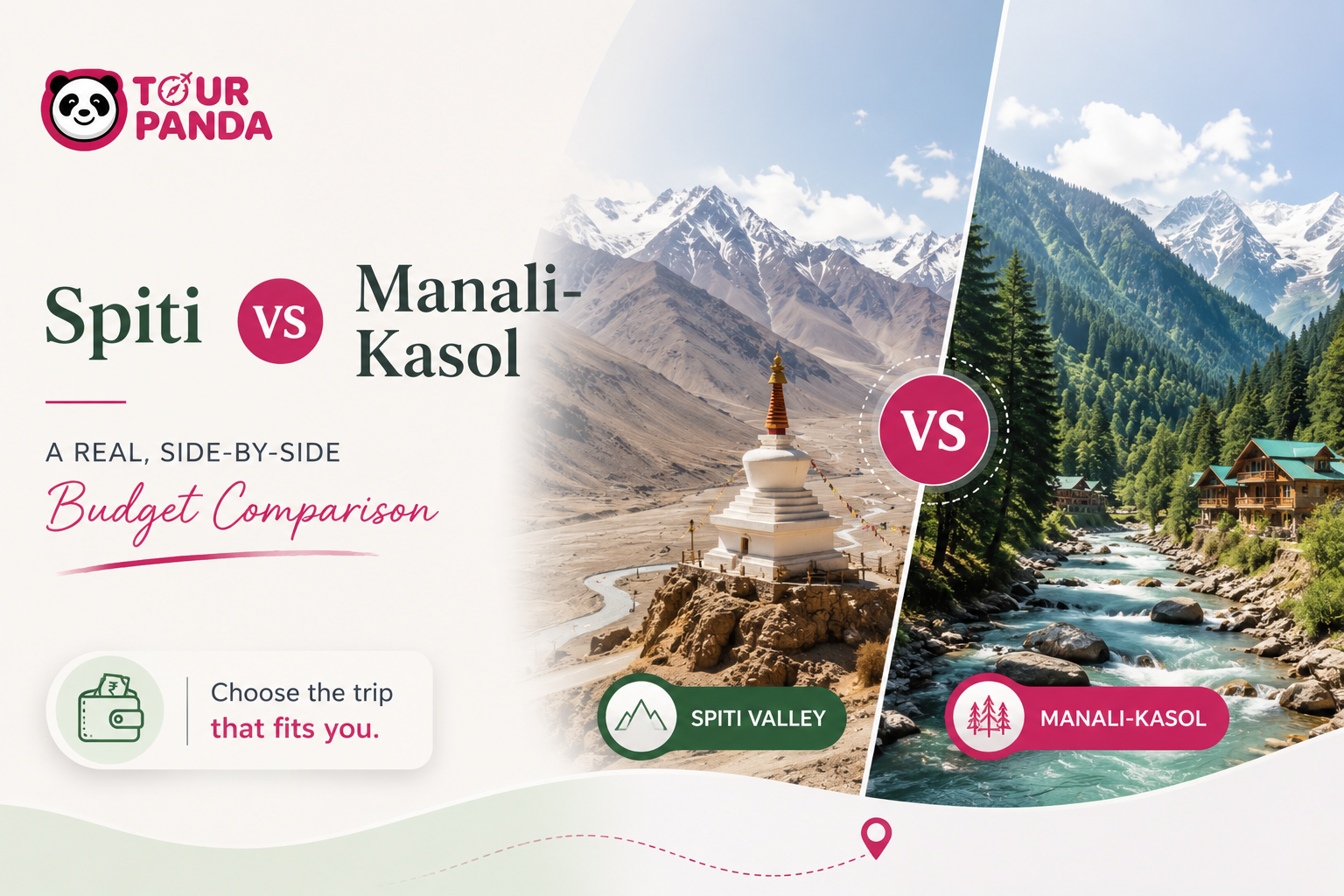
Tour Panda Spiti vs Manali-Kasol: A Real, Side-by-Side Budget Comparison
Aug 30, 2026 By Admin
Spiti vs Manali-Kasol: A Real, Side-by-Side Budget Comparison

Both are genuinely popular Himachal getaways, both get recommended constantly in the same breath — but Spiti Valley and Manali-Kasol are actually quite different trips. Tour Panda's own published data on both makes the real differences easy to see side by side.Real Cost, Side by SideTierSpiti ValleyManali-KasolBudget₹20,000 – ₹25,000₹6,500 – ₹8,000Mid-Range₹22,000 – ₹30,000₹13,500 – ₹15,500Premium₹35,000 – ₹45,000₹24,500 – ₹35,000Group Package Starting Price₹15,999 (7-day)₹5,999 (4-day)Manali-Kasol is genuinely, substantially cheaper at every tier — reflecting real differences in distance, altitude infrastructure demands, and trip duration, not simply arbitrary pricing.Real Duration and Distance, Side by SideFactorSpiti ValleyManali-KasolTypical Trip Length5-7 days4-7 daysCore Route Distance40-55 km trekking route~75 km road routeEntry Distance from Delhi~540 km to Manali, then onward to Kaza~540 km to Manali directlyAltitude Range3,000 – 4,587 metersLower, more moderate elevationsWhy the Cost Gap Is Genuinely Justified, Not ArbitrarySpiti's higher cost reflects real, specific factors — remote, high-altitude villages requiring more logistically complex transport, fewer accommodation options at extreme elevation, and the additional planning required around altitude sickness prevention. Manali-Kasol's lower, more accessible pricing reflects a genuinely simpler, more established travel corridor.Who Each Trip Actually FitsSpiti Valley Fits You If...You want genuine remoteness and cold-desert Himalayan landscapeYou're comfortable with a real trekking commitmentYou have 5-7 days and a somewhat higher budgetYou're prepared for altitude and want the full experience: Kibber, Langza, Hikkim, Komic, DhankarManali-Kasol Fits You If...You want an accessible, café-culture Himalayan escapeYou're newer to Himalayan travel or traveling with less trekking experienceYou have a shorter window (as little as 4 days) or a tighter budgetYou want optional light trekking (Tosh) or moderate trekking (Kheerganga), not mandatory multi-day trekkingReal Altitude Health Considerations, ComparedA peer-reviewed study published in High Altitude Medicine & Biology found that even lifelong residents of Spiti Valley show a 28.7% prevalence of Chronic Mountain Sickness. This level of altitude-related health consideration simply doesn't apply the same way to Manali-Kasol's lower, more moderate elevations. Real Seasonal Timing, ComparedDestinationPrime WindowSpiti ValleyMid-June to mid-July, with September offering post-monsoon clarityManali-KasolSeptember to November, and March to JuneManali-Kasol offers genuinely more flexible timing across two distinct seasonal windows, while Spiti's trekking window is comparatively narrower and more altitude-dependent.Can You Actually Do Both?With a full week, add an Atal Tunnel day with a Keylong visit, or extend into a longer Spiti Valley circuit. This confirms a genuine, practical extension path — Manali-Kasol travelers with additional time can extend toward Spiti, rather than treating the two as entirely mutually exclusive trips.A Practical Decision ChecklistCheck your actual available time. Manali-Kasol works even in 4 days; Spiti genuinely needs 5-7.Check your actual budget. Manali-Kasol's group packages start meaningfully lower than Spiti's.Be honest about your fitness and altitude readiness. Spiti's elevation and trekking demands are genuinely greater.Consider what kind of experience you actually want. Remote cold-desert villages versus accessible valley café culture are genuinely different trips.Consider extending, not choosing. A full week can realistically combine elements of both.Compare Real Packages for Both TripsSpiti Valley starting from ₹15,999, or Manali-Kasol starting from ₹5,999 — compare verified agent packages for both with Tour Panda.Chat on WhatsApp →Spiti Valley and Manali-Kasol get recommended in the same breath, but they're genuinely different trips — different cost, different altitude demands, different seasonal windows, and different traveler profiles. A real, side-by-side look at the actual numbers makes the right choice for your own situation considerably clearer.Whichever fits your time, budget, and fitness level, Tour Panda lets you compare verified agent packages for both, rather than guessing based on generic, undifferentiated Himalayan travel advice.Note: This article reflects information published by Tour Panda on tourpanda.in at the time of writing, including cited data from a peer-reviewed altitude sickness study and regional tourism sources. Pricing, road conditions, and seasonal accessibility may change; please confirm current details directly with Tour Panda before booking.© 2026 Tour Panda • tourpanda.in • support@tourpanda.in • +91-8766373460

Tour Panda When to Book What: A Season-by-Season Himalayan Travel Calendar
Aug 30, 2026 By Admin
When to Book What: A Season-by-Season Himalayan Travel Calendar

Booking a Himalayan trip on the wrong dates can mean the difference between clear mountain views and a washed-out road closure. Tour Panda's own destination guides reveal a real, distinct calendar worth understanding before you book anything.March – June: The Manali-Kasol Sweet Spot OpensWhat's Actually HappeningPeak season for Manali-Kasol — snow at Solang and Rohtang, a lively café scene in Kasol. This is also when the Kunzum Pass typically reopens for vehicles, unlocking direct Manali-to-Kaza access toward Spiti.The BRO confirmed Kunzum Pass (4,551 m) reopened for 4×4 vehicles on 12 May 2026 — meaning this window is specifically when the Manali route into Spiti becomes viable again after winter closure.Mid-June – Mid-July: Spiti Valley's Prime WindowWhat's Actually HappeningPeak trekking season for Spiti — dry trails, wildflowers, Kaza temperatures 10-20°C. This overlaps with the tail end of Manali-Kasol's own peak season.July – September: The Monsoon WarningWhat's Actually Happening — Treat This With Real CautionOfficial Kullu tourism data published in The Tribune showed Indian tourist arrivals to Kullu-Manali cratering from 4,92,533 in June 2025 to just 72,670 in July, 28,196 in August, and 12,238 in September — a 97% drop caused by catastrophic monsoon-triggered landslides on the Chandigarh-Manali highway.This isn't a minor seasonal dip — it's a near-total collapse in travel volume for a specific, documented reason: road safety. If travel during this window is unavoidable, Tour Panda's own guidance recommends adding a 2-day buffer and travel insurance covering road-closure extensions.September – November: The Genuine Second Sweet SpotWhat's Actually HappeningThe sweet spot for Manali-Kasol — monsoon over, Parvati Valley clear, apple orchards in season, crowds thinning noticeably after October.September specifically also offers post-monsoon clarity for Spiti, ideal for photography, though temperatures there drop to 5-15°C daytime and below freezing at night.October: Spiti's Closing WindowWhat's Actually HappeningTrails begin closing in Spiti as early snowfall blocks passes — this marks the practical end of the trekking season there, even as Manali-Kasol remains genuinely pleasant.December – February: Snow, But Limited AccessWhat's Actually HappeningSnow arrives, but many high passes — including Rohtang without special permit — close for the season, limiting the routes actually accessible during this window.A Real Reason Behind the Calendar: Fewer Crowds in 2026Official data from the Himachal Pradesh Tourism Department shows that Lahaul-Spiti domestic tourist arrivals dropped over 53% in 2025 compared to 2024. For trekkers heading into Spiti in 2026, this means significantly fewer crowds, better homestay availability, and more authentic village experiences compared to the peak years of 2022-2024.Putting the Full Calendar TogetherWindowBest ForCaution LevelMarch – JuneManali-Kasol peak season, Kunzum Pass reopensLow — but expect crowds and full bookingsMid-June – Mid-JulySpiti Valley prime trekking windowLowJuly – SeptemberAvoid unless necessaryHigh — monsoon landslide riskSeptember – NovemberManali-Kasol's genuine second sweet spotLowSeptember (specifically)Spiti post-monsoon clarityLow, but coldOctoberSpiti trails closingMedium — check current conditionsDecember – FebruarySnow season, limited pass accessMedium — route-dependentWhy This Calendar Matters More Than Generic "Best Time to Visit" AdviceGeneric travel advice often treats "the Himalayas" as a single, undifferentiated season block. In reality, Spiti's window and Manali-Kasol's window only partially overlap, and the monsoon risk isn't evenly distributed either — real, region-specific data changes the calculation considerably compared to a vague "summer is best" recommendation.A Practical Checklist for Timing Your TripConfirm which specific destination you're targeting. Spiti and Manali-Kasol have genuinely different optimal windows.Avoid July through September unless truly necessary. The documented 97% tourist arrival drop reflects a real, serious landslide risk.Consider September specifically for Spiti photography. Post-monsoon clarity offers a genuine, distinct advantage.Book early for March-June and September-November windows. These genuinely popular periods fill up fastest.Check current pass status before finalizing dates. Kunzum Pass and Rohtang Pass accessibility varies by season and year.Book at Exactly the Right TimeCompare verified agent packages timed to the real seasonal calendar — plan your next Himalayan trip with Tour Panda.Chat on WhatsApp →A Himalayan trip planned around the actual seasonal calendar, rather than generic assumptions, means avoiding documented risk windows and catching genuine sweet spots most travelers miss. Whether it's Spiti's June-July prime window, Manali-Kasol's dual sweet spots, or specifically avoiding the monsoon's real, well-documented disruption, Tour Panda's own destination data offers a genuinely more precise way to time your next trip.Note: This article reflects information published by Tour Panda on tourpanda.in at the time of writing, including cited data from the Himachal Pradesh Tourism Department, the Border Roads Organisation, and The Tribune's Kullu tourism reporting. Road conditions and seasonal accessibility may change year to year; please confirm current details directly with Tour Panda before booking.© 2026 Tour Panda • tourpanda.in • support@tourpanda.in • +91-8766373460

Tour Panda Beyond Manali and Spiti: 7 Underrated Himalayan Destinations Worth Adding to Your List
Aug 29, 2026 By Admin
Beyond Manali and Spiti: 7 Underrated Himalayan Destinations Worth Adding to Your List

Everyone's been to Manali. Fewer people can say they've stood in a village that's literally the last one before the Indo-Tibet border. Tour Panda's real destination catalog goes well beyond the handful of names that dominate every group chat trip suggestion.Why It's Worth Looking Past the Obvious RouteManali, Kasol, and Spiti Valley are genuinely wonderful — but their popularity also means crowds, inflated peak-season prices, and an experience shaped as much by other tourists as by the place itself. A number of destinations sitting quietly within Tour Panda's own catalog offer a genuinely different kind of trip.1. ChitkulThe last inhabited village before the Indo-Tibet border in the Sangla Valley — a genuinely different kind of remoteness than anything on the standard Manali circuit.2. Sangla Holi GetawayA dedicated getaway option centered on the Sangla Valley, distinct from the more heavily-trafficked Kullu-Manali corridor entirely.3. KalpaA quieter Kinnaur Valley destination, offering a genuinely different Himalayan landscape and pace from the adventure-hub energy of Manali.4. Jibhi & Tirthan Valley GetawayA dedicated combined getaway package covering two genuinely underrated valleys, known for a slower, more forested character than the high-altitude drama of Spiti or Kasol.5. Chandranahan LakeA destination with its own dedicated listing, distinct from the more commonly searched Chandratal — genuinely off the radar for most first-time Himachal travelers.6. Jalori PassSitting within the broader Tirthan-Jibhi region, offering high-altitude pass scenery without the crowds that gather at more famous passes like Rohtang.7. Nag Tibba TrekA trek destination distinct from the more commonly discussed Himachal circuits, offering a genuinely different trekking experience within the broader Himalayan catalog.Why "Underrated" Doesn't Mean "Less Developed for Travel"Each of these destinations sits within the same structured, comparison-based booking platform as Manali or Spiti — meaning access to KYC-verified agents, side-by-side package comparison, and the same 24/7 support applies just as fully to these lesser-known names as to the most popular ones.How These Compare to the Popular CircuitPopular DestinationGenuinely Comparable AlternativeManaliJibhi & Tirthan Valley — similar Himachal setting, genuinely quieter paceRohtang PassJalori Pass — high-altitude scenery, fewer crowdsChandratalChandranahan Lake — a distinct, less-searched lake destinationKasolChitkul or Sangla — remote village character rather than café cultureWhy Timing Still Matters, Even for Offbeat DestinationsChoosing a lesser-known destination doesn't remove the need for proper seasonal planning — high Himalayan passes and remote valleys still carry genuine weather and accessibility considerations tied to specific windows through the year, the same way Kunzum Pass has its own defined opening dates for Spiti.A Practical Checklist for Choosing an Offbeat Himalayan TripConsider what draws you to the mountains in the first place. Remoteness, forested valleys, and high-altitude passes each point toward different specific destinations.Don't assume "underrated" means "underdeveloped for travel." The same verified-agent comparison model applies across the full destination catalog.Research seasonal accessibility for your specific choice. Remote destinations often carry their own distinct weather windows.Consider pairing two nearby underrated spots. Combined getaways, like the Jibhi & Tirthan Valley package, let you cover more ground in one trip.Compare packages before booking, just as you would for a popular destination. The same verification principles apply regardless of how well-known the destination is.Discover a Destination Most Travelers Haven't SeenFrom Chitkul to Jibhi to Jalori Pass — explore genuinely underrated Himalayan destinations, compared and verified the same way as the popular ones, with Tour Panda.Explore All Destinations →The most photographed Himalayan destinations earned their popularity for real reasons — but that same popularity also means crowds and inflated pricing that a genuinely underrated destination simply doesn't carry. Chitkul, Sangla, Kalpa, Jibhi, and the rest of this list offer a real alternative, not a lesser one.With the same KYC-verified agent comparison model applied across its full destination catalog, Tour Panda makes it just as easy to plan a trip to a village most people have never heard of as it is to book another Manali weekend.Note: This article reflects the destination catalog published by Tour Panda on tourpanda.in at the time of writing. Destination availability, accessibility, and seasonal conditions may vary; please contact Tour Panda directly for current details before planning your trip.© 2026 Tour Panda • tourpanda.in • support@tourpanda.in • +91-8766373460